Fell asleep at the wheel


Fell asleep at the wheel
How many times have you heard in the news or from fellow truckers, discussing the causes of an accident, these words: “Fell asleep at the wheel”?
Many drivers, especially young and inexperienced ones, will say:
- How is that possible? If you feel sleepy, just stop and rest;
- Drink some coffee or an energy drink;
- No, if I feel sleepy, I’d never get behind the wheel;
- He must’ve been on something, and so on.
But what if that’s not entirely true, or not true at all?
A typical story of an ordinary truck driver.
Let’s imagine a situation familiar to many truck drivers: on a normal workday, at 5:00 in the morning, already loaded, you leave the parking lot. You’ve had a good night’s sleep, didn’t drink alcohol yesterday or in the past few days, and you feel great.
Outside, it’s a sunny summer morning with a light breeze, your truck is in perfect condition, the fuel tanks are full, and the route is set in the navigation and well-known to you. The next stop is in 4 hours and 20, at most 30 minutes. This is required by the working and rest time regulations for drivers in the European Union.
You are an experienced driver, 30–45 years old, you know everything, can handle anything, and have done this a hundred times before. Before departure, you made yourself a cup of instant coffee, didn’t quite finish it, and hit the road.
Your truck slowly pulls out of the parking lot onto the acceleration lane, the left turn signal is on, the highway is empty, no one is in your way. You calmly change lanes and take your spot in the right lane. You accelerate to “cruising speed,” turn on the cruise control. Adjusting the sun visors on the windshield so the sun doesn’t blind you, you turn on your favorite music, enjoy the familiar scenery, and head toward your unloading point, occasionally glancing in the mirrors and finishing your coffee.
Is this already a dream or…?
Time passes, the miles fly by, the coffee has long been finished… Traffic on the road becomes heavier, more and more cars overtake you, and you see your fellow truckers more frequently.
Now, you’ve been on the road for three hours. The road is straight, occasionally winding left or right. Nothing disturbs you, nothing happens. You hear the steady hum of the engine, the tires rolling against the asphalt, and the music playing.
Pleasant thoughts about home, your wife, and children come to mind… You start to recall how you spent time with them at the seaside… Over time, the thoughts grow clearer, the music becomes quieter, and images appear before your eyes… the noise of the road and the engine blend into a monotonous hum…
That very moment
Now imagine that at this very moment, just around the next bend, there’s road construction. Because of this, everyone needs to merge left, as the right lane is closed. However, due to heavy traffic, two lanes are not enough to accommodate everyone. Drivers begin to slow down, a chain reaction occurs, and after 1-2 kilometers, trucks in the right lane are forced not just to reduce speed but to stop. A classic traffic jam forms.
You, mentally somewhere on the azure coast with your loved ones, but physically behind the wheel of a truck carrying a 24-ton load, are traveling at 82-85 km/h, approaching another bend in the road.
Your eyes are open, the truck is moving in its lane, you see the road, but mentally you are not here. Your brain is generating images and dreams, your reactions are slowed. You take the right-hand bend of the highway, with the view blocked by dense trees lining the road. Then everything happens in slow motion:
Coming out of the turn, you see a truck ahead, but due to your state, you can’t immediately recognize that it’s stationary. Losing that crucial second, maybe two, you begin to act thanks to your experience and practiced reflexes.
At this moment, you are still not fully out of a state resembling sleep, but you’re a professional and act instinctively:
- Your foot immediately and accurately moves to the brake pedal (when a driver is on cruise control and there are no dangers ahead, the feet are usually in a comfortable position).
- Your right hand simultaneously activates the hazard lights to warn the driver who might be behind you.
- Your brain calculates whether there’s enough distance to come to a complete stop, factoring in braking efficiency, while your eyes search for a chance to swerve left.
- The brakes are maxed out, ABS kicks in, and… some sixth sense tells you there’s enough room… You stopped… Staring in horror at the side mirror, keeping the brake pedal down… phew, the colleague behind also stopped in time, and the one after him managed to merge left and passed by… crisis averted.
But often, it happens that someone didn’t make it, couldn’t, or the distance was too short to stop. Then, in the local news, we see similar pictures:
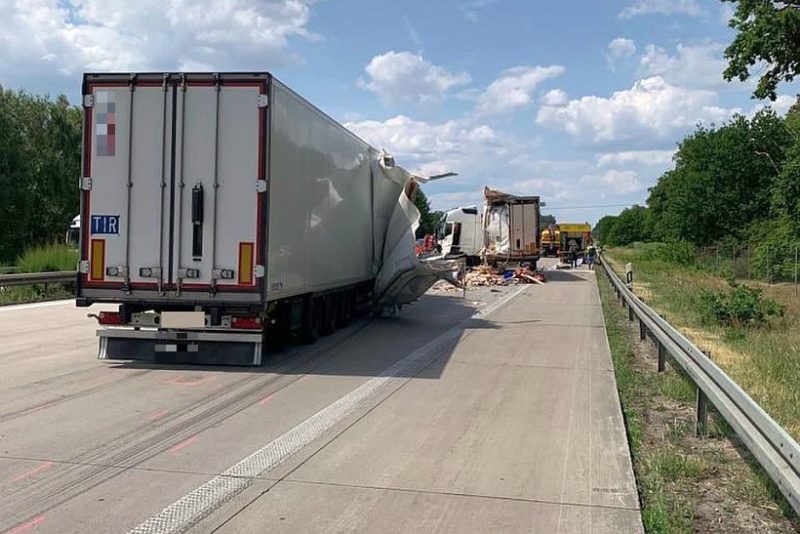
What was that? I wasn’t asleep! How can this be avoided?
Does coffee really help you stay awake?
It seems like a strange question because everyone knows that hot coffee in the morning invigorates you. Yes, it’s true, and it’s been proven not only by scientists but also by ordinary lovers of this divine drink.
The reason behind your energy boost, good mood, and desire to conquer the world is caffeine.
Here’s how it works its magic on our bodies:
- blocks drowsiness, relieves fatigue, and increases alertness;
- boosts adrenaline production, which raises blood pressure and accelerates heart rate;
- increases the amount of the happiness hormone, dopamine, so coffee improves your mood and makes you feel happier and more energized.
It seems like this drink was made for truck drivers, as all these properties are invaluable for us.
But, unfortunately, that’s not entirely true. Coffee beans, besides caffeine, also contain the alkaloid theobromine. This substance has the opposite effect on the body.
Caffeine is found in the outer shell of the coffee bean, while theobromine is inside. Theobromine helps dilate blood vessels and lowers blood pressure.
The better the quality of the coffee, the more caffeine it contains. Since caffeine is used in the production of medicines, the coffee we see on store shelves contains very little of it.
Initially, caffeine blocks the effects of the alkaloid and starts working faster. While caffeine is in control, we feel great. But 25-30 minutes after finishing your cup of coffee, caffeine starts to lose its effect. Your mood stays good, but theobromine kicks in, producing a relaxing effect. If there are no stimulants or active tasks at that moment, your energy drains away, and you enter a state similar to drowsiness.
I think everyone understands that the caffeine content in instant coffee is significantly lower.
What to do to avoid falling asleep at the wheel?
This is quite individual, but here are a few tips from people who have studied this issue.
- About 20-25 minutes after drinking a cup of coffee, take a few sips of water — this will help avoid the drowsiness effect. In general, drink more water; it’s the simplest and most accessible energy elixir for your body.
- Try to avoid chronic sleep deprivation, as over time, sleep deficit accumulates, and a cup of coffee no longer energizes but makes you even sleepier.
- Coffee with milk. Doctors recommend drinking milk with honey before bedtime to improve sleep. If you add milk to coffee, the effect might be similar. Avoid adding too much sugar, syrups, or milk to your coffee.
Cause of the accident: “Fell asleep at the wheel!”
In previous sections, we discussed a situation where everything ended well for the truck driver. He didn’t fall asleep at the wheel but only felt drowsy, lost vigilance, and attention. But what if he had consumed alcohol the night before, was hungover, or even drunk?
Or if he had slept only 2 hours instead of 7… The result would be the same…
So, take care of yourself, monitor your condition. In our job, the punishment is not a warning or a fine but a senseless, foolish death.
The tachograph is your friend; it ensures you don’t overwork, get enough sleep, and feel fine. All these rules are written in the blood of drivers. Respect and remember those who have already paid for their carelessness.
If you feel drowsy, drink some water, stop at the nearest parking area, wash your face, and take a walk in the fresh air.
If you feel an overwhelming urge to sleep, tell the dispatcher to go to hell and take a nap. Even 15-20 minutes of sleep can save a life — and not just yours.
Some statistics behind the words “Fell asleep at the wheel”
According to NHTSA (National Highway Traffic Safety Administration) and the Insurance Institute for Highway Safety (Triple-I), drowsy, sleepy, fatigued, sick, or unconscious drivers were responsible for 2.1% of fatal accidents in 2022 in the United States. 693 people died. Over 1,261 drivers involved in fatal accidents admitted they were drowsy.
It’s important to note that not every driver admits to falling asleep at the wheel or being drowsy while driving. The real numbers are much higher. According to CDC (Centers for Disease Control and Prevention) data, only 1 in 25 drivers admits to falling asleep behind the wheel.
No coordinates.